

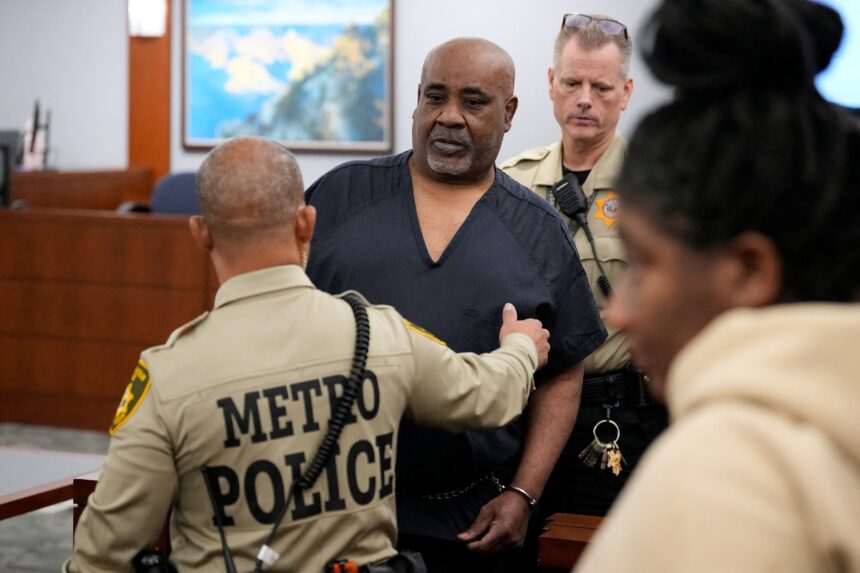
Thirty years after the killing of rap icon Tupac Shakur stunned the music world, a Las Vegas courtroom has delivered a major moment in one of hip-hop’s most closely followed murder cases. On October 13, 2026, former gang leader Duane “Keffe D” Davis, 63, was sentenced to 40 years to life in prison for orchestrating the 1996 shooting.
A Nevada jury convicted Davis of first-degree murder in August. Judge Carli Kierny imposed two consecutive sentences of 20 years to life, one for the murder and another for the use of a deadly weapon. Davis is the only person ever charged in connection with the rapper’s death, and his lawyers have said they intend to appeal.
Tupac was just 25 when he was shot on September 7, 1996, while riding in a vehicle driven by Death Row Records executive Marion “Suge” Knight. The pair had attended a Mike Tyson boxing match in Las Vegas. Later that night, a vehicle pulled alongside theirs and gunfire erupted. Tupac suffered multiple gunshot wounds and died six days later, leaving fans around the world devastated.
Prosecutors argued that the attack was retaliation for a confrontation earlier that evening at the MGM Grand casino. Tupac and members of his entourage had been involved in an altercation with Orlando Anderson, Davis’s nephew. According to the prosecution, Davis then helped gather associates, supplied a gun and pursued the rapper’s vehicle. Authorities have not conclusively established who actually fired the fatal shots.
For decades, the investigation appeared to have reached a dead end. A breakthrough came after Davis publicly discussed the shooting in interviews and in his 2019 memoir, Compton Street Legend. Investigators used those accounts as important evidence, and he was arrested in 2023. His defense argued that the stories had been exaggerated and challenged the lack of physical evidence connecting him to the killing. The jury nevertheless found him guilty.
The sentencing was especially emotional for Tupac’s family. His sister, Sekyiwa Shakur, spoke about the brother she lost and the future that was taken from him. The judge also stressed the human cost of the crime, beyond the worldwide attention it attracted.
Tupac remains one of hip-hop’s defining voices, remembered for songs such as Changes, Dear Mama and California Love. His music explored inequality, violence, ambition and survival, themes that still resonate with new generations.
The sentence marks a historic development, but not necessarily the final legal chapter. With an appeal planned, proceedings may continue. For Tupac’s loved ones and millions of fans, however, the ruling represents a long-awaited moment of accountability in a tragedy that shaped music history.